
Theory: ride smarter, ride safer
This is your reference for the training session. As your instructor presents each topic, open the lesson to read the detail, then answer the one-question check to test your understanding. Your progress and answers are saved on this device.
0 of 9 lessons complete (0%)
1 What worries you about riding?
Before we get into the rules, take a moment to think about what makes you nervous on a bike. Naming the worry is the first step to managing it.
What are the risks or worries you have about riding?
For example: being hit by a car turning across me, traffic on busy roads, riding in the rain.
How can you approach those issues and manage those risks?
For example: using back streets where I can, taking the lane when it's too narrow to pass, making eye contact and slowing down at crossings.
We'll work through the strategies for managing these risks together as the session goes on.
2 Roadworthiness: the ABCDQ check
Know the rules and best strategies to reduce your risks and ride with confidence. A quick, simple roadworthy for your bike is the ABCDQ check.
- A: Air for your tyres. Keep the pressure within the range written on the tyre sidewall.
- B: Brakes working and not rubbing or with pads worn down.
- C: Chain is not dusty, rusty or stiff. Wipe down and lube if it is, or replace.
- D: Drop and listen for rattles. Tighten any loose parts.
- Q: Quick releases must be in the closed position (wheel axle fastenings, seat post clamp, etc).
Run this before every ride
It takes under a minute and catches most problems before they become breakdowns. The pre-ride check walks you through the fleet-specific version.
In the ABCDQ check, what does the “D” stand for?
“Drop” means dropping the bike gently and listening for rattles, then tightening anything loose.
3 Fitting your helmet
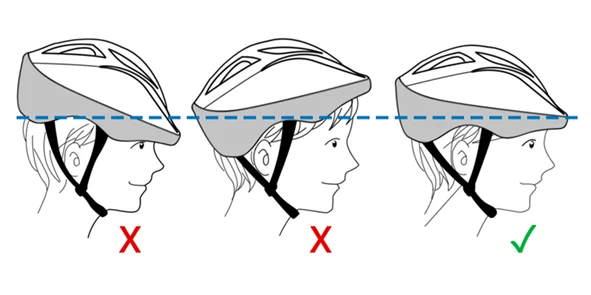
A helmet only protects you if it fits. Get these three things right:
- It should sit two finger-widths above your eyebrows.
- The strap should have about a finger space under your chin.
- Adjust the side buckles to make a “V” that meets just under your ears.
How far above your eyebrows should your helmet sit?
Two finger-widths above the eyebrows keeps the front of the helmet low enough to protect your forehead.
4 Sharing the road with traffic
Cross traffic
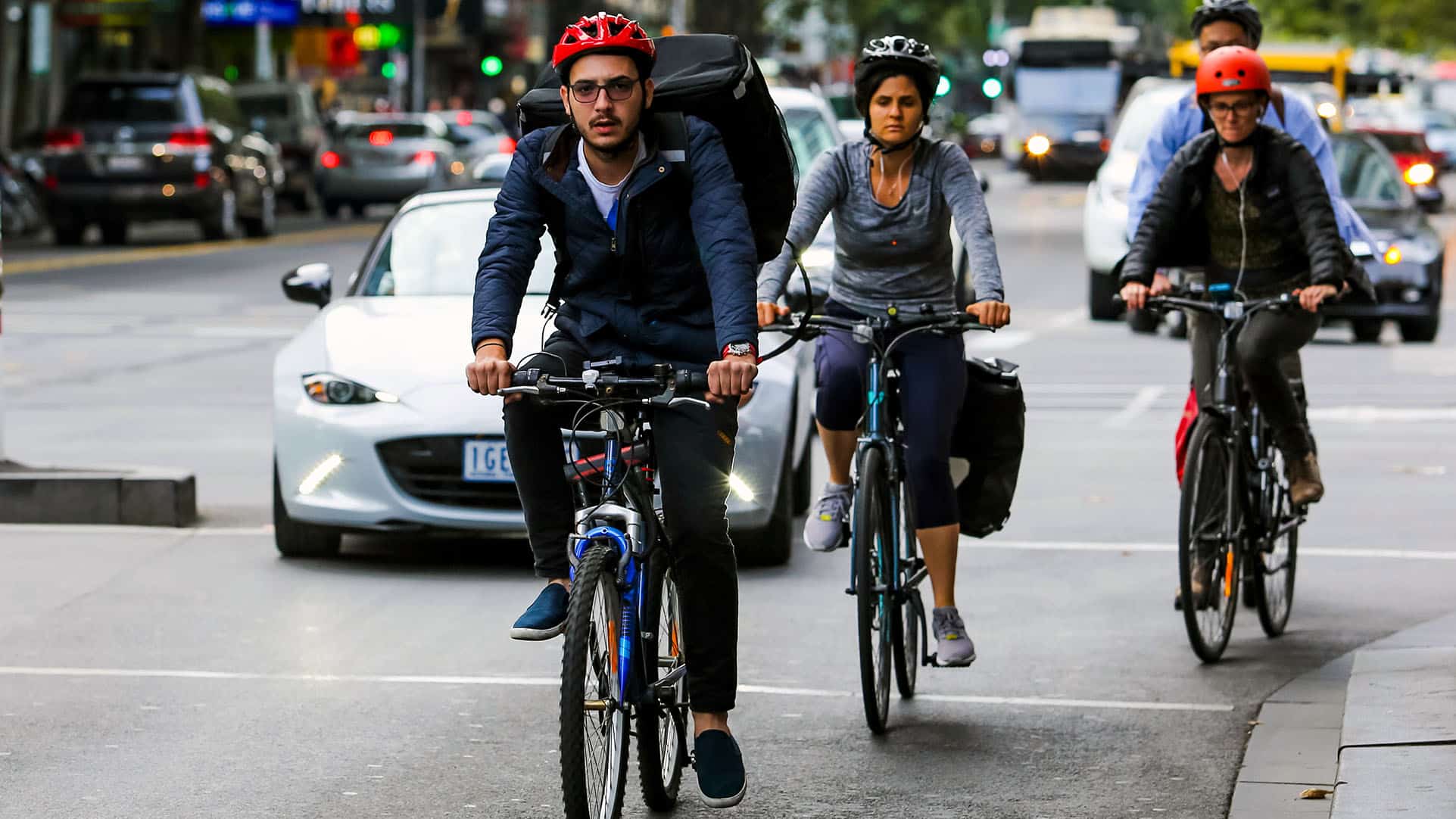
The main causes of serious crashes for riders are drivers crossing their path. The number one risk is the right cross, a driver from the opposite direction turning right across you. Always scan for this, and don't proceed past a gap in stopped traffic without scanning for a car coming through, even if someone waves you through.
The number two risk is cross traffic simply not seeing riders. Try to make eye contact with any driver crossing your path. If you can't, slow down and be prepared to give way.
Work with traffic
Motorists get confused when riders swerve around parked cars or pop out of bike lanes that end. Instead, scan ahead, then check, indicate and merge to the right well before the obstacle. When passing intermittent parked cars, ride in a straight line to the right of them rather than weaving back and forth.
When a street is too narrow for a car to pass, remove the temptation for them to try and move into the centre of the lane. Move back to the left when there is room again.
What is the number one cause of serious crashes for bike riders?
A driver from the opposite direction turning right across your path (the right cross) is the biggest single cause.
5 Communicating: bell, voice, signals & position
Bell and voice
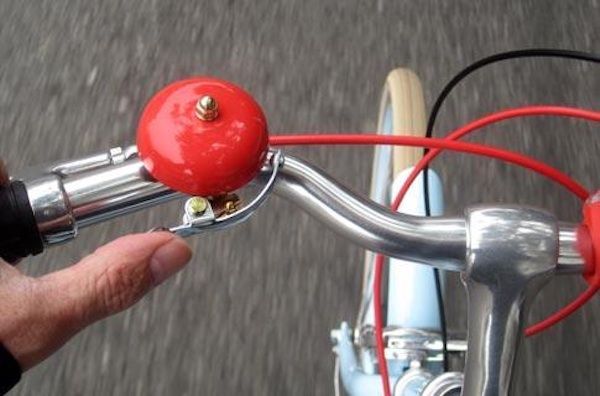
To let someone know you're overtaking or crossing their path, use your bell or your voice. This goes for other riders and pedestrians on a shared path.
“Passing” is a commonly used call, and “Hello” does the job too. “Coming through” is effective as well. What is not effective is “On your right”: it tends to confuse people and can make them step into your path. Calling out “Stopping” is useful to prevent riders behind running into you, especially if you stop in a hurry.
Signalling
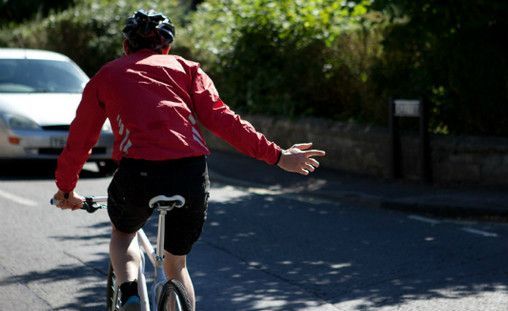
The only signal riders in Australia are legally required to make is the right-turn signal. But to keep traffic flowing and avoid collisions, it's a really good idea to signal turning, changing lanes, overtaking and pulling over: basically everything that isn't riding straight ahead. Signal stopping too, especially for riders behind you.
Make a clear signal with a straight arm, held out for a couple of seconds. Often it's necessary to signal a second time, such as at an intersection where you have to give way.
Road positioning
Your road position is body language. It tells others where you're going and whether you're confident. The default is to keep left, but that isn't best in every situation. Signalling a right turn from the left is confusing; and where the road is too narrow for a car to safely pass, manage your own safety by moving into the lane.
Which call is least effective when overtaking someone on a shared path?
“On your right” tends to confuse people: they sometimes step to their right, into your path. “Passing” or “Hello” works better.
6 Turns & intersections
Choose a hook turn
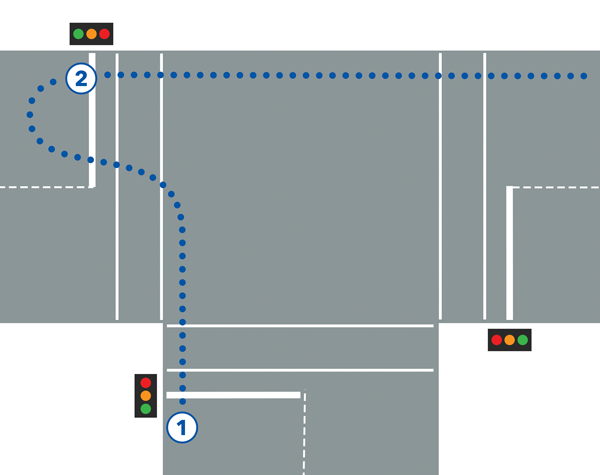
Hook turns may seem weird at first, but they're a great risk-reduction tool for riders turning right. You keep left and you don't have to indicate, cross into the middle of the traffic lane or cross multiple traffic lanes, and you avoid sitting in the middle of an intersection waiting for a gap. You make the turn in two stages. Bike riders can make a hook turn at any intersection unless signs specifically prohibit it.
Roundabouts
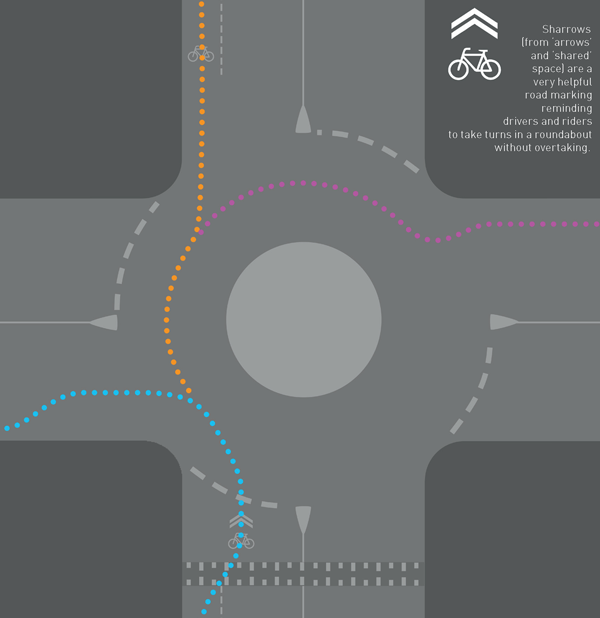
For everyone's benefit, move to the centre of the lane on approach to the roundabout, the earlier the better. Indicate clearly and take your turn with confidence. If you're not confident, pull over before the roundabout, dismount and walk through as a pedestrian. Avoid double-lane roundabouts; dismount and walk if you come across one.
Overtaking on the left
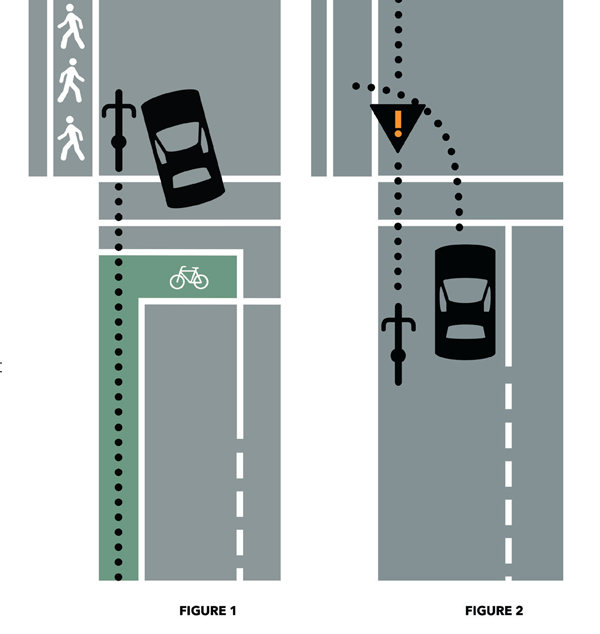
Riders can overtake on the left but must give way to drivers turning left. If a rider and driver arrive at an intersection side-by-side, the one in front has right of way and the one behind gives way. Remember it can be difficult (sometimes impossible) for drivers to see a bike on their left, so be prepared to give way even if you believe you have right of way.
What makes a hook turn safer when you want to turn right?
Keeping left through two stages avoids crossing lanes and sitting in the middle of an intersection.
7 Blind spots & large vehicles
Vehicle blind spots blot out far more road than most people realise: areas a driver cannot see even with mirrors. A 2011 RACV study found that in some vehicles a cyclist as close as nine metres away couldn't be seen because of a side blind spot.
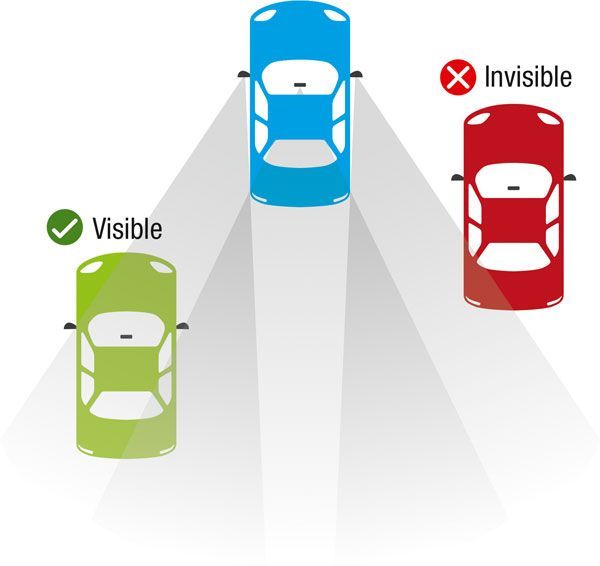
Blind spots and trucks
Large vehicles occupy the space riders normally use to pass on the left. When sharing the road with them, the left side is a highly risky place to be. The major blind spots are directly behind and to the side.
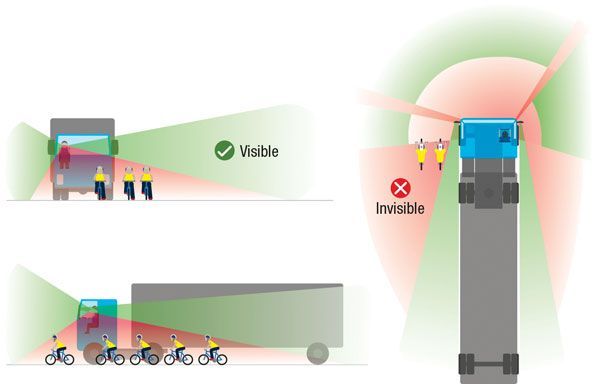
- Right-hand blind spot: dangerous when overtaking: you may not be seen if the vehicle pulls out to the right.
- Don't move in front of a truck (even into a bike box) because the blind spot under the windscreen can stretch more than two metres ahead.
- Left-hand blind spot: the greatest risk. As a large vehicle turns, the space inside closes up where the trailing wheels cut in tight to the kerb.
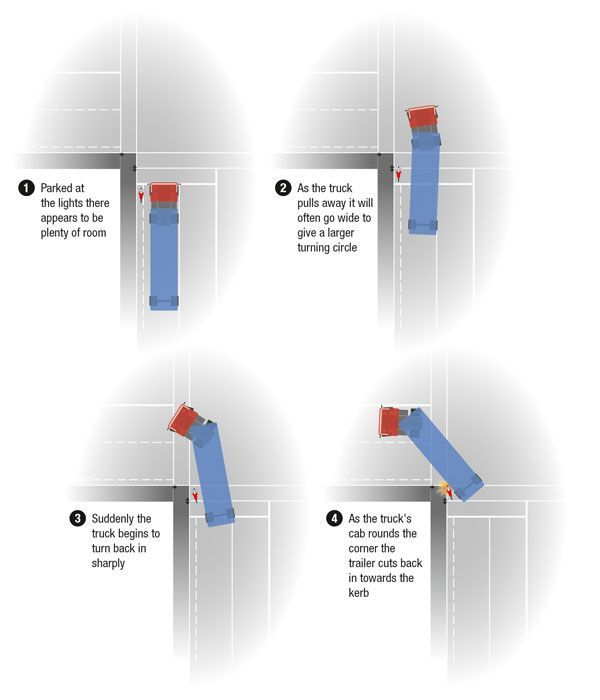
Assume you haven't been seen
Stay well back and let a large vehicle complete its turn, even if you are technically in the right. If a truck turns in front of you, escape onto the footpath.
When sharing the road with a large vehicle, where is the most dangerous place to be?
The left-hand blind spot is the greatest risk: the trailer cuts back toward the kerb as the truck turns.
8 Conflict & incidents on the road
Sadly, conflict and road rage can be common for bike riders. It's often caused by poor infrastructure, congestion, or a misunderstanding of riders' rights. Here's how to handle it.
Don't engage or retaliate
As tempting as it is to vent, retaliating doesn't achieve anything. Don't approach the other person or touch their property: it can be seen as aggression and put you in danger. Keep your emotions in check; telling someone to “relax” can inflame things. Watch your tone and body language, and be the bigger person. Someone yelling at you wants you to engage. Don't.
Stay calm and get the details
After an incident your words and actions matter. Try to get the other person's details. If a driver is uncooperative, get their registration number, but don't put yourself in danger. If there are witnesses, get their details too. You can't get too much information.
Report it
Report an incident to police straight away. Even if the person isn't charged, police may still issue a warning. If it isn't reported and there's no property damage, there are no repercussions and behaviour won't change.
If another road user is aggressive toward you, what's the best response?
Don't engage or retaliate. Stay calm, avoid danger, and collect details so you can report it.
9 The e-bike advantage
Everyone could use a bit of extra oomph sometimes, and that's exactly what an e-bike provides: up to 250 watts more power, roughly doubling what your legs put out on their own.
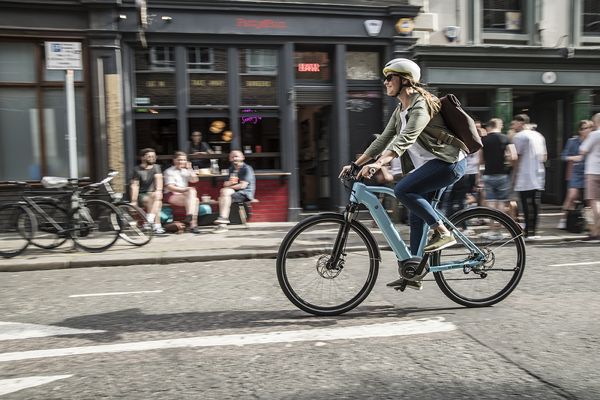
In Australia, e-bikes provide pedal assistance up to 25 km/h. That allows 80–100 km of riding range on one charge. Lower assistance levels use less battery, while hilly terrain and under-inflated tyres make the motor work harder and drain the battery faster.
Keep fresh, and it's not cheating
People with e-bikes ride 2–3 times more than those without. You still have to turn the pedals to get moving, and you decide how much assistance you want, from Eco all the way up to Turbo. It's not about replacing the “pushie”; it's another healthy way to get around.
These are power-assist bikes
You need to pedal and use the gears at all times for a smooth, powerful ride. If the pedals are spinning too fast you won't get the assist you need to climb a hill.
In Australia, up to what speed do e-bikes provide pedal assistance?
Pedal assistance cuts out at 25 km/h in Australia.